Mammy
Mammy is the well-nigh well known and enduring racial caricature of African American women. The Jim Crow Museum at Ferris State University has more than 100 items with the mammy paradigm, including ashtrays, souvenirs, postcards, fishing lures, detergent, creative prints, toys, candles, and kitchenware. This article examines real mammies, fictional mammies, and commercial mammies.
Real Mammies
From slavery through the Jim Crow era, the mammy image served the political, social, and economical interests of mainstream white America. During slavery, the mammy extravaganza was posited as proof that blacks -- in this case, black women -- were contented, fifty-fifty happy, as slaves. Her wide smile, hearty laugher, and loyal servitude were offered as evidence of the supposed humanity of the establishment of slavery.
This was the mammy caricature, and, like all caricatures, it independent a little truth surrounded by a larger prevarication. The caricature portrayed an obese, coarse, maternal effigy. She had not bad dearest for her white "family," just often treated her own family with disdain. Although she had children, sometimes many, she was completely desexualized. She "belonged" to the white family, though it was rarely stated. Unlike Sambo, she was a faithful worker. She had no black friends; the white family was her entire world. Obviously, the mammy caricature was more myth than accurate portrayal.
Catherine Clinton (1982), a historian, claimed that existent antebellum mammies were rare
Records do acknowledge the presence of female slaves who served as the "correct hand" of plantation mistresses. Yet documents from the planter course during the first 50 years following the American Revolution reveal only a handful of such examples. Not until after Emancipation did black women run white households or occupy in any meaning number the special positions ascribed to them in folklore and fiction. The Mammy was created by white Southerners to redeem the relationship between black women and white men inside slave order in response to the antislavery set on from the North during the ante-bellum period. In the primary records from before the Ceremonious War, hard evidence for its beingness simply does not appear.(pp. 201-202)
Co-ordinate to Patricia Turner (1994), Professor of African American and African Studies, before the Ceremonious War only very wealthy whites could afford the luxury of "utilizing the (black) women every bit house servants rather than equally field hands" (p. 44). Moreover, Turner claims that house servants were usually mixed raced, skinny (blacks were not given much food), and young (fewer than 10 percent of black women lived beyond l years). Why were the fictional mammies so dissimilar from their existent-life counterparts? The reply lies squarely inside the complex sexual relations between blacks and whites.
Abolitionists claimed that one of the many savage aspects of slavery was that slave owners sexually exploited their female person slaves, peculiarly light-skinned ones who approximated the mainstream definition of female sexual attractiveness. The mammy extravaganza was deliberately constructed to suggest ugliness. Mammy was portrayed as nighttime-skinned, often pitch blackness, in a society that regarded black pare as ugly, tainted. She was obese, sometimes morbidly overweight. Moreover, she was often portrayed as onetime, or at to the lowest degree middle-anile. The endeavor was to desexualize mammy. The implicit assumption was this: No reasonable white man would choose a fat, elderly black woman instead of the arcadian white woman. The blackness mammy was portrayed as defective all sexual and sensual qualities. The de-eroticism of mammy meant that the white married woman -- and by extension, the white family unit, was prophylactic.
The sexual exploitation of blackness women past white men was unfortunately mutual during the antebellum flow, and this was true irrespective of the economic relationship involved; in other words, black women were sexually exploited by rich whites, center class whites, and poor whites. Sexual relations between blacks and whites -- whether consensual or rapes -- were taboo; yet they occurred often. All blackness women and girls, regardless of their physical appearances, were vulnerable to existence sexually assaulted by white men. The mammy extravaganza tells many lies; in this example, the lie is that white men did non notice black women sexually desirable.
The mammy extravaganza unsaid that black women were only fit to be domestic workers; thus, the stereotype became a rationalization for economic discrimination. During the Jim Crow menstruation, approximately 1877 to 1966, America's race-based, race-segregated job economy limited most blacks to menial, low paying, low condition jobs. Blackness women found themselves forced into i chore category, house retainer. Jo Ann Gibson Robinson (1987), a biographer of the Civil Rights Movement, described the limited opportunities for black women in the 1950s:
Jobs for clerks in dimestores, cashiers in markets, and telephone operators were numerous, but were not open to black women. A l-dollar-a-week worker could employ a black domestic to make clean her home, cook the nutrient, wash and iron dress, and nurse the babe for as niggling as twenty dollars per week. (p. 107)
During slavery only the very wealthy could afford to "buy" black women and use them every bit "firm servants," just during Jim Crow fifty-fifty centre class white women could hire black domestic workers. These blackness women were not mammies. Mammy was "black, fatty with huge breasts, and head covered with a kerchief to hibernate her nappy hair, strong, kind, loyal, sexless, religious and superstitious" (Christian, 1980, pp. eleven-12). She spoke bastardized English language; she did not care about her advent. She was politically condom. She was culturally rubber. She was, of course, a figment of the white imagination, a nostalgic yearning for a reality that never had been. The real-life black domestics of the Jim Crow era were poor women denied other opportunities. They performed many of the duties of the fictional mammies, simply, unlike the caricature, they were dedicated to their own families, and often resentful of their lowly societal status.
Fictional Mammies
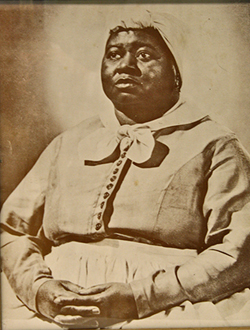
The slavery-era mammy did not want to be free. She was too busy serving as surrogate mother/grandmother to white families. Mammy was and so loyal to her white family that she was oft willing to take chances her life to defend them. In D. W. Griffith's picture The Nascence of a Nation (1915) -- based on Thomas Dixon'southward racist novel The Clansman (1905) -- the mammy defends her white chief's abode confronting black and white Matrimony soldiers. The message was clear: Mammy would rather fight than be free. In the famous movie Gone With The Wind (Selznick & Fleming, 1939), the black mammy also fights blackness soldiers whom she believes to be a threat to the white mistress of the firm.
Mammy constitute life on vaudeville stages, in novels, in plays, and finally, in films and on television receiver. White men, wearing black face makeup, did vaudeville skits equally Sambos, Mammies, and other anti-black stereotypes. The standard for mammy depictions was offered past Harriet Beecher Stowe's 1852 book, Uncle Tom's Cabin. The volume'south mammy, Aunt Chloe, is described in this way:
A circular, blackness, shiny face is hers, so glossy as to suggest the idea that she might take been done over with the whites of eggs, like one of her own tea rusks. Her whole plump countenance beams with satisfaction and contentment from under a well-starched checky turban, bearing on it; however, if we must confess it, a piddling of that tinge of self-consciousness which becomes the first cook of the neighborhood, as Aunt Chloe was universally held and acknowledged to be.(Stowe, 1966, p. 31)
Aunt Chloe was nurturing and protective of "her" white family, but less caring toward her own children. She is the prototypical fictional mammy: cocky-sacrificing, white-identified, fat, asexual, good-humored, a loyal cook, housekeeper and quasi-family member.
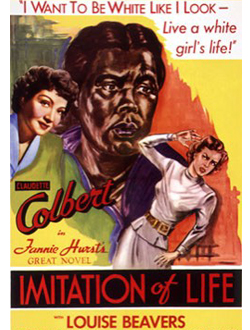
During the first half of the 1900s, while blackness Americans were demanding political, social, and economic advancement, Mammy was increasingly popular in the field of amusement. The first talking motion picture was 1927's The Jazz Singer (Crosland) with Al Jolson in greasepaint singing "Mammy." In 1934 the movie Imitation of Life (Laemmle & Stahl) told the story of a black maid, Aunt Delilah (played past Louise Beavers) who inherited a pancake recipe. This movie mammy gave the valuable recipe to Miss Bea, her boss. Miss Bea successfully marketed the recipe. She offered Aunt Delilah a twenty per centum interest in the pancake visitor.
"You'll have your own machine. Your own firm," Miss Bea tells Aunt Delilah. Mammy is frightened. "My own house? You lot gonna transport me away, Miss Bea? I can't live with y'all? Oh, Honey Republic of chile, please don't send me abroad." Aunt Delilah, though she had lived her entire life in poverty, does non want her ain firm. "How I gonna take intendance of you and Miss Jessie (Miss Bea's daughter) if I ain't here... I'se your cook. And I want to stay your cook." Regarding the pancake recipe, Aunt Delilah said, "I gives it to yous, Beloved. I makes you a present of it" (Bogle, 1994, p. 57). Aunt Delilah worked to keep the white family stable, but her ain family disintegrated -- her self-antisocial daughter rejected her, and then ran away from home to "pass for white." Nigh the movie'due south conclusion, Aunt Delilah dies "of a cleaved centre."
Imitation of Life was probably the highlight of Louise Beavers' acting career. Almost all of her characters, before and afterwards the Aunt Delilah function, were mammy or mammy-like. She played hopelessly naive maids in Mae West's She Done Him Incorrect (Sherman, 1933), and Jean Harlow's Bombshell (Stromberg & Fleming, 1933). She played loyal servants in Made for Each Other (Selznick & Cromwell, 1939), and Mr. Blandings Builds His Dream Business firm (Frank, Panama & Potter, 1948), and several other movies.
Beavers had a weight problem: it was a constant boxing for her to stay overweight. She oft wore padding to requite her the appearance of a mammy. Also, she had been reared in California, and she had to fabricate a southern accent. Moreover, she detested cooking. She was truly a fictional mammy.
Imitation of Life was remade (without the pancake recipe storyline) in 1959 (Hunter & Sirk). It starred Lana Turner equally the white mistress, and Juanita Moore (in an Oscar-nominated Best Supporting Extra performance) equally the mammy. It was also a tear-jerker.
Hattie McDaniel was another well known mammy portrayer. In her early films, for instance The Golden Westward (Grainger & Howard, 1932), and The Story of Temple Drake (Glazer & Roberts, 1933), she played unobtrusive, weak mammies. Withal, her role in Judge Priest (Wurtzel & Ford, 1934) signaled the beginning of the sassy, choleric mammies that she popularized. She played the saucy mammy in many movies, including, Music is Magic (Rock & Marshall, 1935), The Little Colonel (DeSylva & Butler, 1935), Alice Adams (Berman & Stevens, 1935), Saratoga (Hyman & Conway, 1937), and The Mad Miss Manton (Wolfson & Jason, 1938). In 1939, she played Scarlett O'Hara's sassy simply loyal retainer in Gone With the Wind. McDaniel won an Oscar for best supporting actress, the first black to win an Academy Award.
Hattie McDaniel was a gifted extra who added depth to the grapheme of mammy; unfortunately, she, similar almost all blacks from the 1920s through 1950s, was typecast as a servant. She was frequently criticized past blacks for perpetuating the mammy caricature. She responded this manner: "Why should I complain virtually making seven g dollars a week playing a maid? If I didn't, I'd exist making seven dollars a week really beingness one" (Bogle, 1994, p. 82).
Beulah was a telly testify, popular from 1950 to 1953, in which a mammy nurtures a white suburban family. Hattie McDaniel originated the role for radio; Louise Beavers performed the role on goggle box. The Beulah prototype resurfaced in the 1980s when Nell Carter, a talented black singer, played a mammy-like role on the situation one-act Gimme a Pause. She was dark-skinned, overweight, sassy, white-identified, and similar Aunt Delilah in Imitation of Life, content to live in her white employer'southward domicile and nurture the white family.
Commercial Mammies
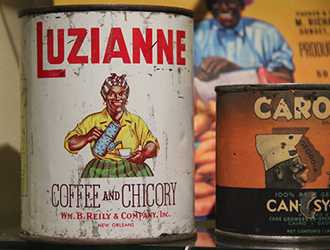
Mammy was born on the plantation in the imagination of slavery defenders, merely she grew in popularity during the period of Jim Crow. The mainstreaming of Mammy was primarily, but not exclusively, the upshot of the fledging ad manufacture. The mammy image was used to sell almost any household item, peculiarly breakfast foods, detergents, planters, ashtrays, sewing accessories, and beverages. As early on as 1875, Aunt Emerge, a Mammy image, appeared on cans of baking powder. Later, unlike Mammy images appeared on Luzianne coffee and cleaners, Fun to Wash detergent, Aunt Dinah molasses, and other products. Mammy represented wholesomeness. You can trust the mammy pitchwoman.
Mammy's near successful commercial expression was (and is) Aunt Jemima. In 1889, Charles Rutt, a Missouri paper editor, and Charles G. Underwood, a manufacturing plant possessor, developed the idea of a cocky-rising flour that just needed water. He called it Aunt Jemima's recipe. Rutt borrowed the Aunt Jemima name from a popular vaudeville vocal that he had heard performed by a squad of minstrel performers. The minstrels included a skit with a southern mammy. Rutt decided to employ the name and the paradigm of the mammy-like Aunt Jemima to promote his new pancake mix. Unfortunately for him, he and his partner lacked the necessary capital to effectively promote and market place the production. They sold the pancake recipe and the accompanying Aunt Jemima marketing idea to the R.T. Davis Mill Visitor.

The R.T. Davis Company improved the pancake formula, and, more importantly, they developed an advertising plan to use a real person to portray Aunt Jemima. The woman they found to serve as the live model was Nancy Dark-green, who was built-in a slave in Kentucky in 1834. She impersonated Aunt Jemima until her death in 1923. Struggling with profits, R.T. Davis Visitor made the bold conclusion to risk their entire fortune and future on a promotional exhibition at the 1893 World's Exposition in Chicago. The Company constructed the world's largest flour barrel, 24 feet high and 12 feet across. Standing near the basket, Nancy Green, dressed as Aunt Jemima, sang songs, cooked pancakes, and told stories nigh the Old South -- stories which presented the South as a happy place for blacks and whites alike. She was a huge success. She had served tens of thousands of pancakes by the fourth dimension the off-white ended. Her success established her as a national celebrity. Her image was plastered on billboards nationwide, with the caption, "I'se in town, honey." Green, in her role every bit Aunt Jemima, made appearances at countless land fairs, flea markets, food shows, and local grocery stores. Past the turn of the century, Aunt Jemima, along with the Armour meat chef, were the two commercial symbols nearly trusted past American housewives (Sacharow, 1982, p. 82). Past 1910 more than 120 million Aunt Jemima breakfasts were beingness served annually. The popularity of Aunt Jemima inspired many giveaway and postal service-in premiums, including, dolls, breakfast club pins, dishware, and recipe booklets.
The R.T. Davis Mill Company was renamed the Aunt Jemima Mills Company in 1914, and eventually sold to the Quaker Oats Visitor in 1926. In 1933 Anna Robinson, who weighed 350 pounds, became the second Aunt Jemima. She was much heavier and darker in complexion than was Nancy Green. The third Aunt Jemima was Edith Wilson, who is known primarily for playing the part of Aunt Jemima on radio and television shows between 1948 and 1966. By the 1960s the Quaker Oats Company was the market leader in the frozen food business, and Aunt Jemima was an American icon. In recent years, Aunt Jemima has been given a makeover: her peel is lighter and the handkerchief has been removed from her head. She now has the appearance of an attractive maid -- not a Jim Crow era mammy.
© Dr. David Pilgrim, Professor of Sociology
Ferris State Academy
Oct., 2000
Edited 2012
References
Berman, P. Southward. (Producer), & Stevens, Thousand. (Director). (1935). Alice Adams [Motility flick]. United States: RKO Radio Pictures.
Bogle, D. (1994). Toms, coons, mulattoes, mammies, and bucks: An interpretive history of Blacks in American films (New 3rd ed.). New York, NY: Continuum.
Clinton, C. (1982). The plantation mistress: Woman's world in the one-time South. New York, NY: Pantheon Books.
Christian, B. (1980). Black women novelists: The evolution of a tradition 1892-1976. Westport, CT.: Greenwood Press.
Crosland, A. (Director). (1927). The jazz singer [Moving picture]. The states: Warner Bros. Pictures.
DeSylva, B. G. (Producer), & Butler, D. (Director). (1935). The picayune Colonel [Motion picture]. United States: Fox Picture Corporation.
Dixon, T. (1905). The clansman: an historical romance of the Ku Klux Klan. New York, NY: Grosset & Dunlap.
Frank, M., & Panama, N. (Producers), & Potter, H. C. (Director). (1948). Mr. Blandings builds his dream house [Movement motion-picture show]. United states of america: RKO Radio Pictures.
Glazer, B. (Producer), & Roberts, S. (Director). (1933). The story of Temple Drake [Motion picture]. United States: Paramount Pictures.
Grainger, E. (Associate Producer), & Howard, D. (Director). (1932). The gold due west [Movement picture]. Usa: Play tricks Film Corporation.
Griffith, D. W. (Producer/Manager). (1915). The birth of a nation [Move picture]. U.s.: David Westward. Griffith Corp.
Hyman, B. H. (Producer), & Conway, J. (Director). (1937). Saratoga [Motion movie]. Us: Metro-Goldwyn-Mayer.
Hunter, R. (Producer), & Sirk, D. (Director). (1959). Imitation of life [Motion picture]. United States: Universal International Pictures.
Laemmle, C. Jr. (Producer), & Stahl, J. M. (Managing director). (1934). Imitation of life [Move picture show]. Us: Universal Pictures.
Robinson, J. A. Chiliad. (1987). The Montgomery autobus boycott and the women who started it: The memoir of Jo Ann Gibson Robinson. Knoxville, TN: University of Tennessee Press.
Sacharow, S. (1982). Symbols of trade: Your favorite trademarks and the companies they represent. New York, NY: Art Management Book Company.
Selznick, D. O. (Producer), & Fleming, V. (Director). (1939). Gone with the air current [Motility flick]. United States: Selznick International Pictures.
Selznick, D. O. (Producer), & Cromwell, J. (Director). (1939). Fabricated for each other [Motion motion picture]. United States: Selznick International Pictures.
Sherman, L. (Director). (1933). She washed him incorrect [Motion motion-picture show]. United States: Paramount Pictures.
Rock, J. (Producer), & Marshall, M. (Director). (1935). Music is magic [Motion picture]. Usa: Play a joke on Film Corporation.
Stowe, H. B. (1966). Uncle Tom's Cabin. New York, NY: New American Library.
Stromberg, H. (Acquaintance Producer), & Fleming, V. (Director). (1933). Bombshell [Motion pic]. United States: Metro-Goldwyn-Mayer.
Turner, P. A. (1994). Ceramic uncles & celluloid mammies: Blackness images and their influence on culture. New York, NY: Ballast Books, 1994.
Wolfson, P. J. (Associate Producer), & Jason, Leigh (Director). (1938). The mad Miss Manton [Motion film]. United States: RKO Radio Pictures.
Wurtzel, S. M. (Producer), & Ford, J. (Managing director). (1934). Judge Priest [Move picture}. United states of america: Fox Moving-picture show Corporation.
Source: https://www.ferris.edu/HTMLS/news/jimcrow/mammies/homepage.htm
0 Response to "Mammy"
Post a Comment